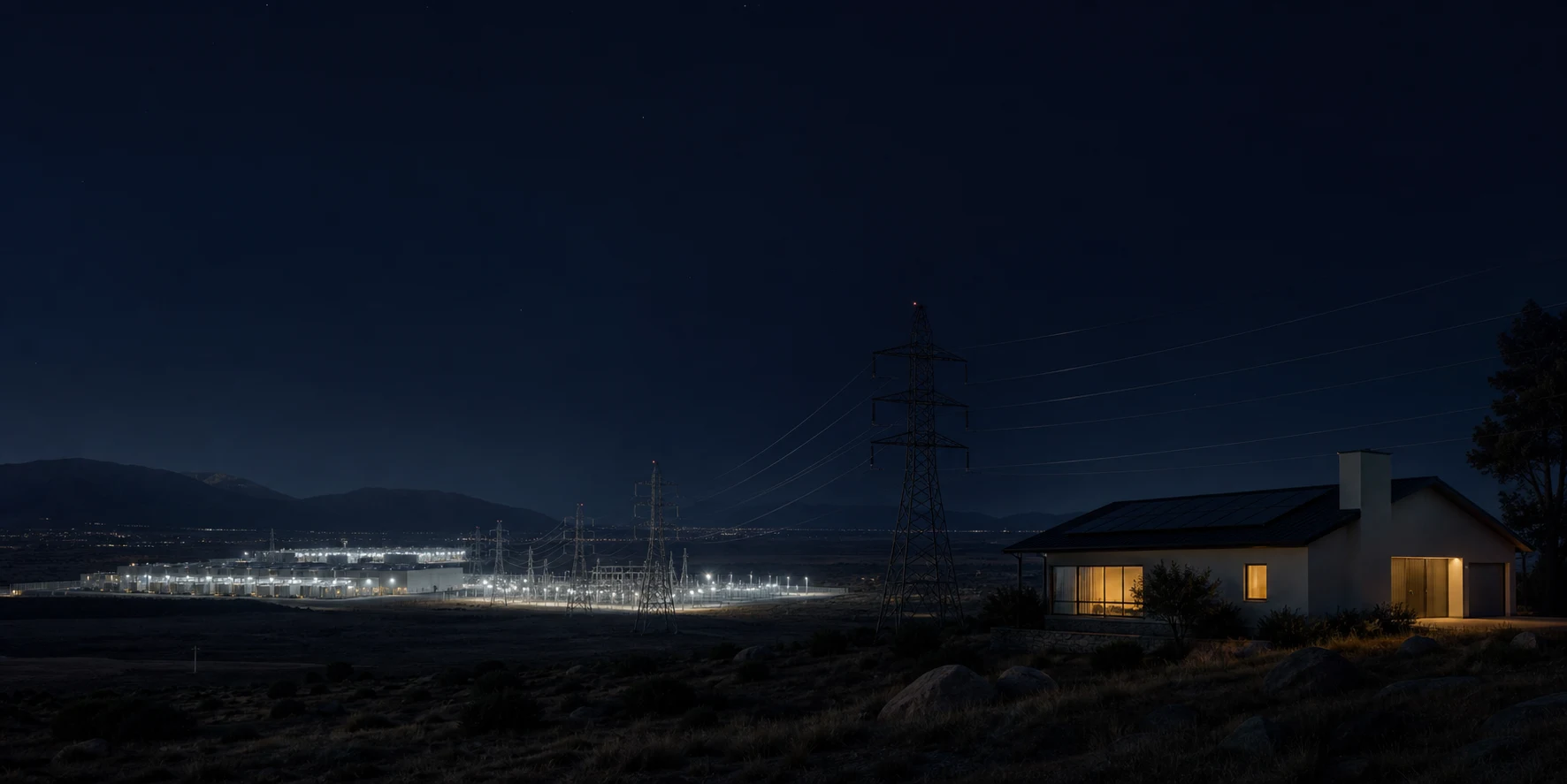
A rural home connected across the landscape to a distant data center and substation at night

The cost of connectedness · 02

Power is not guaranteed. The bill is.

Your consumption can fall while the shared system grows. New load. New capacity. New rate design. You do not control the inputs—but you receive the output.

Rates are regulated and cost allocation is a public-policy process. This page documents the exposure without pretending every cost has one cause.

Demand grows Costs are allocated The bill arrives

A new class of load

Your home now shares a grid with industrial-scale computing.

California’s Energy Commission estimates that data centers represented roughly 1,000 megawatts—about 2% of CAISO peak demand—in early 2026. Its planning projection reaches about 4,500 megawatts, or 9%, by 2040.

A forecast is not destiny. It is a signal that infrastructure planners and regulators are already treating data centers as material electric load.

Infrastructure is not free

New demand requires new capacity.
Who pays is a policy choice.

Large new loads can require network upgrades, generation, and backup capacity. Regulators and utilities decide how much the new customer pays directly, how much enters the broader rate base, and how risk is allocated if a project changes course.

Industrial load applies Infrastructure expands Regulator sets rules Costs reach customer classes

AI demand does not automatically raise your bill dollar-for-dollar. Rate design decides who bears the cost. That decision is exactly the exposure.

The curve keeps moving

California rate forecasts are outrunning inflation.

The CPUC’s September 2025 outlook forecast average annual residential-rate growth from 2025 through 2028 of 6% for PG&E, 7% for SCE, and 6% for SDG&E, against 2.6% inflation.

These are regulatory forecasts, not guaranteed outcomes. Inflation is not the only driver; wildfire mitigation, generation, transmission, financing, and other approved costs also matter.

PG&E
6%
SCE
7%
SDG&E
6%
Inflation
2.6%
CPUC SB 695 report ↗

Connection has a price

Use less. Stay connected.
Still pay.

For customers of California’s three large investor-owned utilities, the base-services charge separates a portion of grid costs from electricity usage. The standard charge is $24.15 per month, with lower income-qualified tiers. Customers with rooftop solar also pay it.

CARE$6

Income-qualified monthly tier.

FERA$12.08

Income-qualified monthly tier.

Standard$24.15

Standard monthly tier.

The charge restructures existing revenue collection and lowers per-kilowatt-hour rates; it is not simply new revenue. The point is narrower: staying connected can carry a bill that energy credits do not erase.

Your electric bill is a policy surface.

Helping lower-income households and funding a reliable shared grid are legitimate public goals. So is recognizing the trade: the commission can change how the obligation is divided, even when your own home is efficient or net-producing.

Oversight is not omniscience

Approved does not always mean effective.

California’s State Auditor has found weaknesses in utility wildfire-mitigation oversight and questioned whether some spending was sufficiently effective or well targeted. Regulation creates accountability. It does not eliminate waste, delay, or imperfect execution.

This is not a claim that every utility dollar is wasted. It is evidence that shared-system spending can miss its objective while customers remain exposed to the cost.

The alternative is optionality

Put the decision at your house.

Independent power is not anger at the grid. It is generation, storage, reserve, and operating rules designed around your actual loads.

Show the receipts